
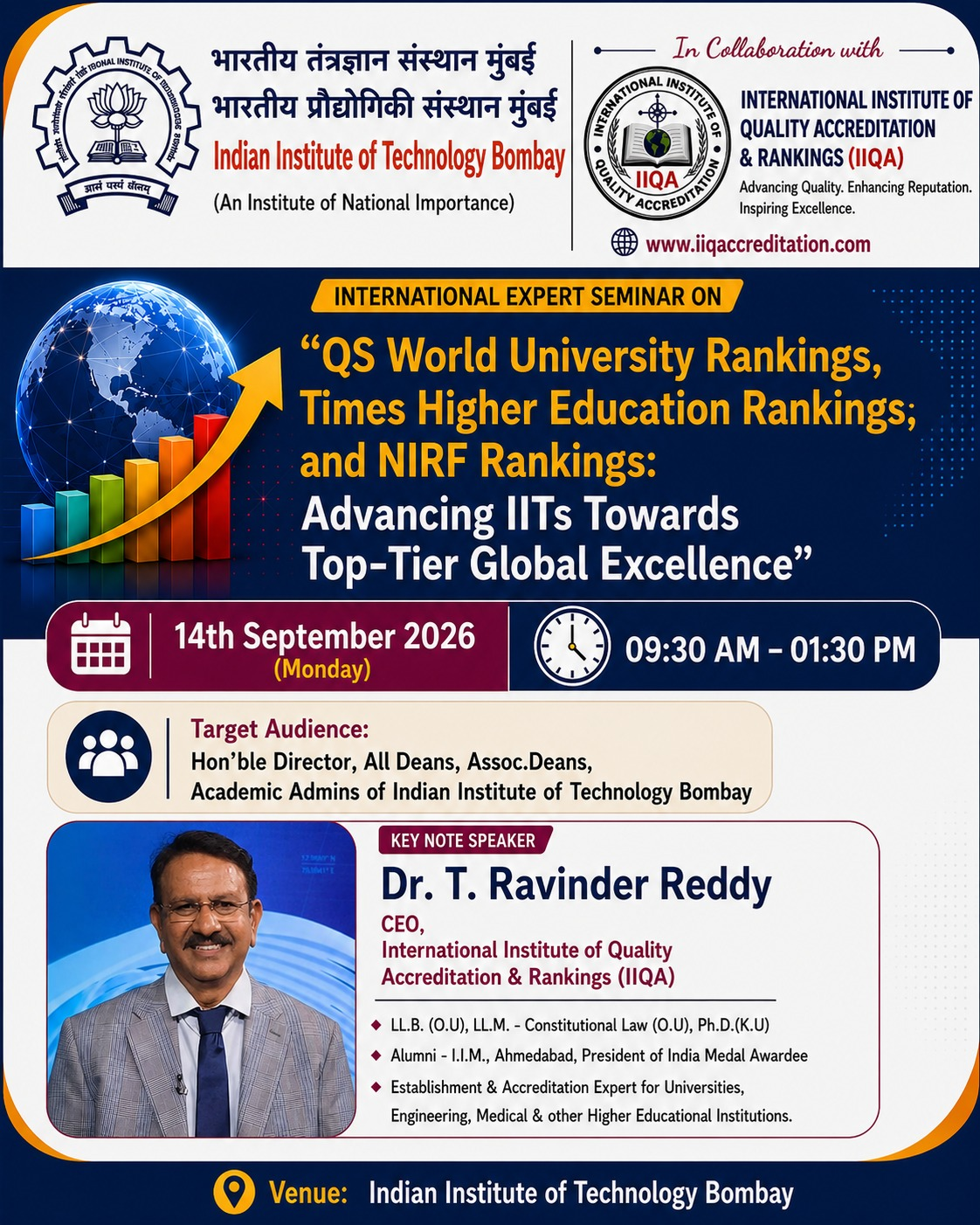
The International Institute of Quality Accreditation & Rankings (IIQA), in collaboration with the Indian Institute of Technology Bombay (IIT Bombay), is set to conduct an International Expert Seminar on QS World University Rankings, Times Higher Education (THE) Rankings, and NIRF Rankings on 14th September 2026 (Monday) at IIT Bombay.
The seminar, themed “QS World University Rankings, Times Higher Education Rankings, and NIRF Rankings: Advancing IITs Towards Top-Tier Global Excellence,” will focus on helping academic leaders understand major national and international university ranking frameworks and explore strategies for strengthening institutional performance, reputation, and global recognition.
The program will be conducted from 09:30 AM to 01:30 PM and will bring together the Hon’ble Director, Deans, Associate Deans, and Academic Administrators of IIT Bombay.
International Expert Seminar on QS, THE & NIRF Rankings
University rankings have become an important benchmark for evaluating and comparing higher education institutions at national and international levels. Ranking frameworks provide institutions with valuable insights into areas such as academic reputation, research performance, teaching quality, internationalization, industry engagement, and institutional perception.
The upcoming seminar will focus on three major ranking frameworks:
- QS World University Rankings
- Times Higher Education (THE) Rankings
- National Institutional Ranking Framework (NIRF)
The seminar will provide an opportunity to understand ranking parameters, institutional performance indicators, benchmarking approaches, and strategies that can support higher education institutions in their journey toward academic and institutional excellence.
Seminar Details
| Details | Information |
| Event | International Expert Seminar on QS, THE & NIRF Rankings |
| Theme | Advancing IITs Towards Top-Tier Global Excellence |
| Date | 14th September 2026 (Monday) |
| Time | 09:30 AM – 01:30 PM |
| Venue | Indian Institute of Technology Bombay |
| Organized By | International Institute of Quality Accreditation & Rankings (IIQA) |
| In Collaboration With | Indian Institute of Technology Bombay (IIT Bombay) |
| Target Audience | Hon’ble Director, Deans, Associate Deans & Academic Administrators of IIT Bombay |
Keynote Speaker: Dr. T. Ravinder Reddy
The seminar will feature Dr. T. Ravinder Reddy, CEO of the International Institute of Quality Accreditation & Rankings (IIQA), as the keynote speaker.
Dr. Ravinder Reddy is an accreditation, quality assurance, and institutional excellence expert with experience in guiding higher education and other institutions toward structured quality improvement and accreditation.
Professional Credentials
- CEO, International Institute of Quality Accreditation & Rankings (IIQA)
- LL.B. – Osmania University
- LL.M. – Constitutional Law, Osmania University
- Ph.D. – Kakatiya University
- Alumni – IIM Ahmedabad
- President of India Medal Awardee
- Establishment & Accreditation Expert
His expertise will provide academic and institutional leaders with practical perspectives on quality enhancement, institutional performance, ranking frameworks, and strategies for achieving greater recognition.
- Understanding QS World University Rankings
The QS World University Rankings are among the widely recognized global university ranking frameworks. The ranking methodology considers different aspects of university performance and reputation.
The seminar will provide insights into areas associated with QS rankings, including:
- Academic reputation
- Employer reputation
- Research performance
- Citations and research impact
- Internationalization
- Faculty and student indicators
- Global academic visibility
- International research collaboration
Understanding these indicators can help institutions identify areas of strength and opportunities for strategic improvement.
Understanding Times Higher Education Rankings
The Times Higher Education (THE) World University Rankings provide another important framework for assessing universities globally.
The seminar will explore key areas associated with THE rankings, including:
- Teaching
- Research environment
- Research quality
- Research impact
- Industry engagement
- International outlook
- Institutional performance
A better understanding of THE ranking indicators can help institutions evaluate their academic and research performance from a global perspective.
Understanding NIRF Rankings
The National Institutional Ranking Framework (NIRF) is an important ranking framework for higher education institutions in India.
The seminar will discuss the major NIRF parameters, including:
- Teaching, Learning & Resources
- Research and Professional Practices
- Graduation Outcomes
- Outreach and Inclusivity
- Perception
Understanding these parameters can help institutions strengthen their academic systems, research activities, student outcomes, outreach initiatives, and overall institutional performance.
Objectives of the Seminar
The primary objective of the seminar is to help academic and institutional leaders develop a deeper understanding of national and international university ranking frameworks.
Key objectives include:
- Understanding QS World University Rankings
- Understanding Times Higher Education rankings
- Understanding NIRF ranking parameters
- Identifying key ranking indicators
- Strengthening academic excellence
- Improving research performance
- Enhancing institutional visibility
- Strengthening international collaborations
- Identifying institutional performance gaps
- Developing data-driven improvement strategies
- Enhancing institutional reputation
- Advancing institutions toward global excellence
The seminar will encourage institutions to view rankings not simply as positions or scores, but as useful benchmarks for identifying opportunities for continuous institutional improvement.
Why QS, THE & NIRF Rankings Matter
University rankings can influence how institutions are perceived by students, researchers, academic partners, industry stakeholders, and the wider higher education community.
QS, THE, and NIRF use different methodologies and indicators to assess institutional performance. Understanding these frameworks allows universities to benchmark their strengths, identify gaps, and develop strategic improvement plans.
Strong performance across relevant areas can contribute to:
- Greater institutional visibility
- Stronger academic reputation
- Increased research recognition
- International collaborations
- Industry engagement
- Student attraction
- Institutional credibility
- Strategic academic planning
For leading higher education institutions, ranking indicators can therefore serve as useful tools for long-term institutional development.
Strategies for Advancing Towards Global Excellence
Achieving stronger performance in national and international rankings requires sustained efforts across multiple areas of institutional development.
Research Excellence
Institutions can strengthen research quality by encouraging high-impact research, quality publications, citations, research collaboration, innovation, and interdisciplinary research.
Academic Excellence
Improving teaching quality, faculty development, curriculum innovation, learning resources, and student outcomes can contribute to stronger academic performance.
- Internationalization
International academic partnerships, global research collaborations, international faculty engagement, student mobility, and cross-border academic initiatives can strengthen an institution's global outlook.
Industry Engagement
Universities can strengthen relationships with industry through collaborative research, innovation, knowledge transfer, internships, consultancy, and industry-supported academic initiatives.
Institutional Reputation
Academic reputation and institutional perception are important components of university rankings. Sustained academic, research, and industry performance can help institutions build stronger recognition.
Data & Performance Management
Accurate institutional data and systematic performance monitoring are essential for understanding ranking indicators and identifying areas that require improvement.
Role of Academic Leadership in Improving University Rankings
Improving university ranking performance requires coordinated efforts across the institution. Academic leadership plays an important role in establishing priorities, monitoring performance, and implementing improvement initiatives.
Directors, Deans, Associate Deans, academic administrators, faculty members, researchers, and institutional teams can contribute to strengthening different ranking indicators.
Effective institutional leadership can help:
- Establish measurable performance goals
- Monitor ranking indicators
- Improve institutional data quality
- Strengthen research output
- Encourage international collaboration
- Improve academic reputation
- Enhance industry partnerships
- Identify institutional gaps
- Promote continuous improvement
- Align institutional strategies with long-term objectives
Expected Outcomes of the Seminar
The International Expert Seminar is expected to provide participants with practical insights into major university ranking frameworks and institutional performance strategies.
Participants will gain a better understanding of:
- QS World University Rankings
- Times Higher Education Rankings
- NIRF Rankings
- Ranking methodologies
- Institutional benchmarking
- Research excellence
- Academic performance
- Internationalization
- Industry engagement
- Institutional reputation
- Data-driven performance improvement
- Global excellence strategies
The knowledge gained during the seminar can support academic leaders in making informed decisions and developing strategies for long-term institutional growth.
IIQA's Role in Quality and Institutional Excellence
The International Institute of Quality Accreditation & Rankings (IIQA) works in the areas of accreditation, quality assurance, institutional development, ranking awareness, training, consultancy, and continuous improvement.
Through expert-led seminars, workshops, awareness programs, and institutional support initiatives, IIQA aims to help educational institutions understand quality frameworks and develop structured approaches toward institutional excellence.
IIQA's areas of support include:
- Accreditation Awareness
- Quality Assurance
- Ranking Awareness
- Institutional Assessment
- Gap Analysis
- Quality Management Systems
- Training & Workshops
- Accreditation Consultancy
- Institutional Excellence
- Continuous Improvement
Through these initiatives, IIQA supports institutions in strengthening their quality systems and developing a culture of continuous improvement.
IIT Bombay and the Pursuit of Global Excellence
The collaboration between IIQA and Indian Institute of Technology Bombay provides an important platform for discussing global university rankings and institutional excellence.
As higher education institutions increasingly operate in a competitive national and international environment, understanding ranking methodologies can help academic leaders make informed decisions about research, teaching, internationalization, industry engagement, and institutional development.
The seminar will provide an opportunity for academic leaders to discuss these areas and explore approaches for advancing IITs toward top-tier global excellence.
A Platform for Knowledge Sharing and Strategic Development
The seminar will serve as a platform for knowledge sharing among academic and institutional leaders. By bringing together expertise in quality, accreditation, rankings, and institutional development, the program aims to encourage strategic thinking around higher education excellence.
Understanding the relationship between institutional quality and ranking performance can help universities build sustainable systems rather than focusing only on short-term ranking outcomes.
A long-term approach involving academic excellence, research impact, international engagement, industry collaboration, and institutional quality can contribute to stronger overall performance.
Conclusion
The International Expert Seminar on QS World University Rankings, Times Higher Education Rankings, and NIRF Rankings, organized by the International Institute of Quality Accreditation & Rankings (IIQA) in collaboration with IIT Bombay, will be conducted on 14th September 2026 (Monday).
The seminar, themed “Advancing IITs Towards Top-Tier Global Excellence,” will provide academic leaders with valuable insights into major university ranking frameworks, ranking indicators, institutional benchmarking, research excellence, internationalization, reputation building, and continuous improvement.
With Dr. T. Ravinder Reddy, CEO of IIQA, as the keynote speaker, the program aims to provide practical perspectives that can support institutional leaders in developing strategies for stronger performance and greater global recognition.
The seminar represents an important initiative toward promoting quality, excellence, strategic institutional development, and global competitiveness in higher education.
FAQs
1. When will the IIQA International Expert Seminar be conducted?
The seminar will be conducted on 14th September 2026 (Monday) from 09:30 AM to 01:30 PM.
2. Where will the seminar be held?
The seminar will be held at the Indian Institute of Technology Bombay (IIT Bombay).
3. Who is organizing the seminar?
The seminar is being organized by the International Institute of Quality Accreditation & Rankings (IIQA) in collaboration with Indian Institute of Technology Bombay (IIT Bombay).
4. What topics will be covered in the seminar?
The seminar will focus on QS World University Rankings, Times Higher Education (THE) Rankings, and NIRF Rankings, including ranking methodologies, institutional performance indicators, and strategies for global excellence.
5. Who is the keynote speaker?
Dr. T. Ravinder Reddy, CEO of the International Institute of Quality Accreditation & Rankings (IIQA), will be the keynote speaker.
6. Who is the target audience for the seminar?
The seminar is intended for the Hon’ble Director, Deans, Associate Deans, and Academic Administrators of IIT Bombay.
7. What is the objective of the seminar?
The objective is to help academic leaders understand major university ranking frameworks and explore strategies for improving academic excellence, research performance, institutional reputation, internationalization, and global competitiveness.
Enquire about institutional support