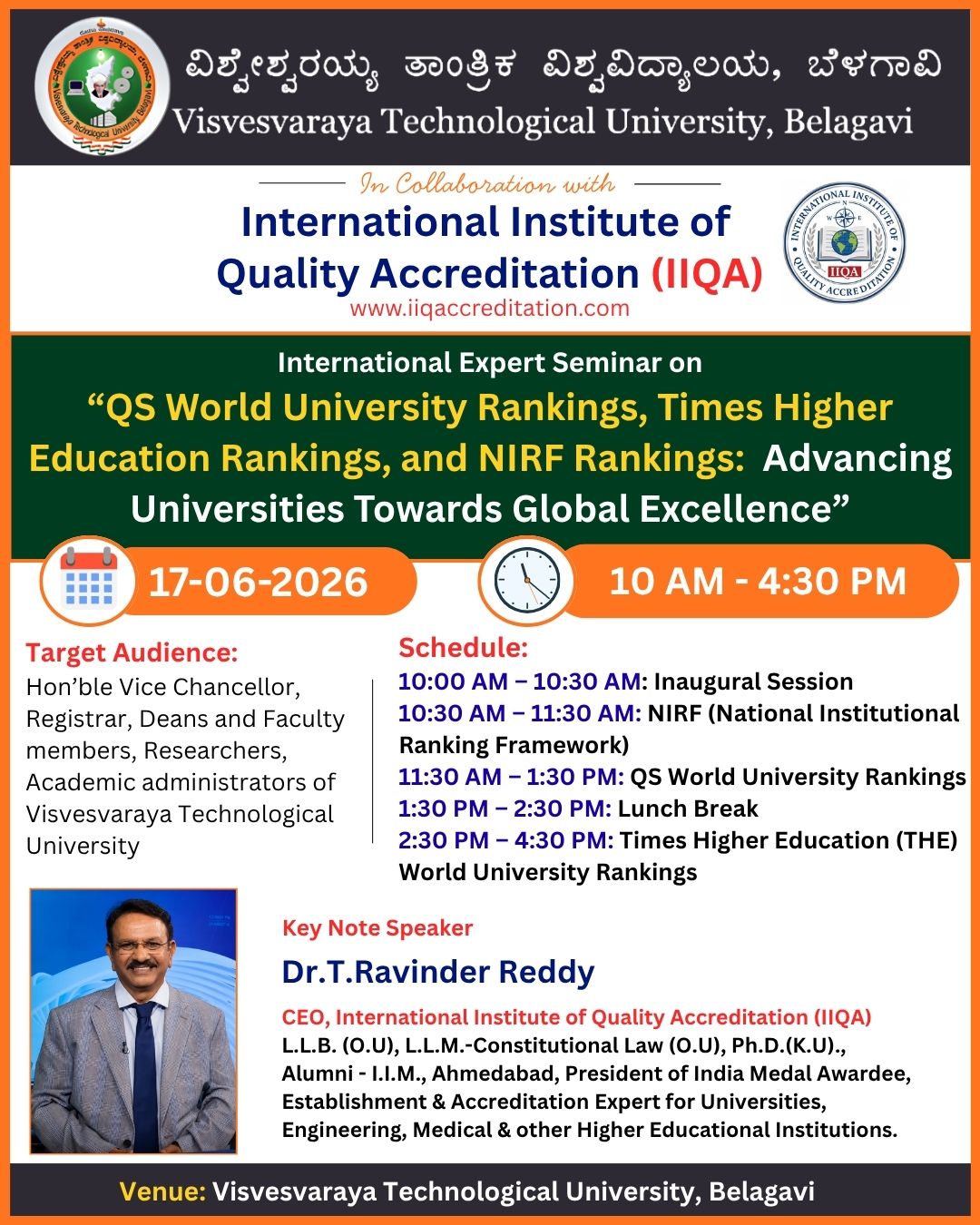
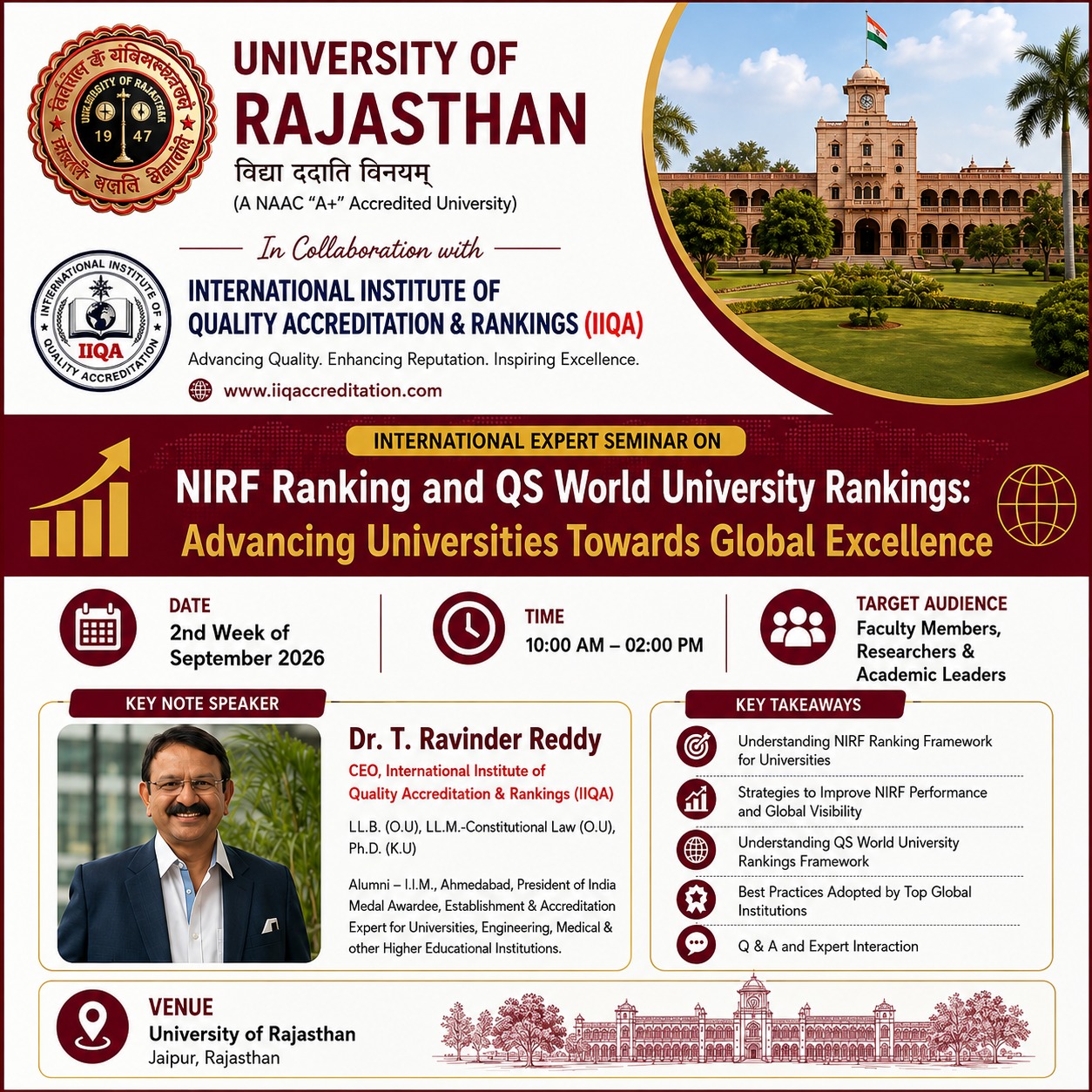
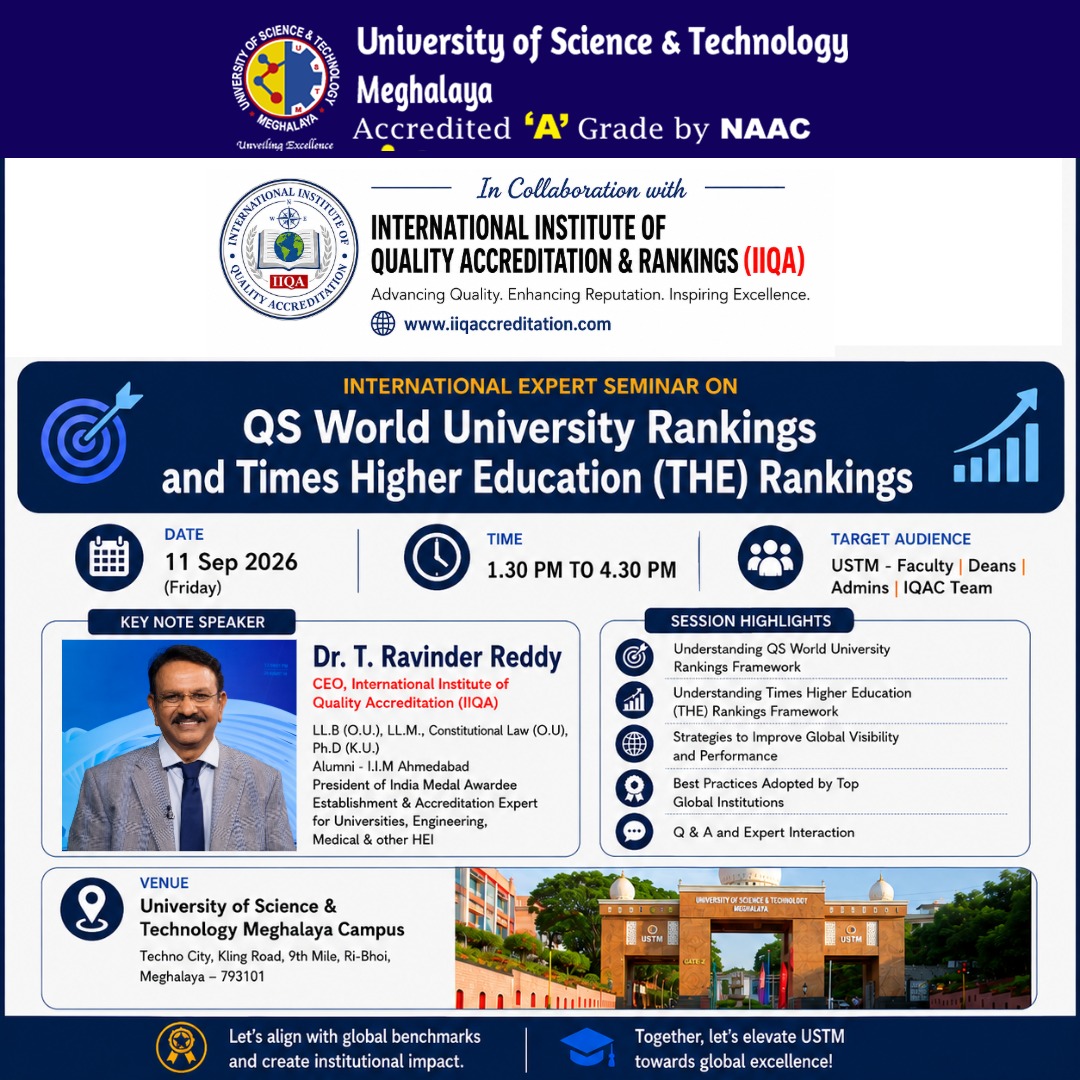
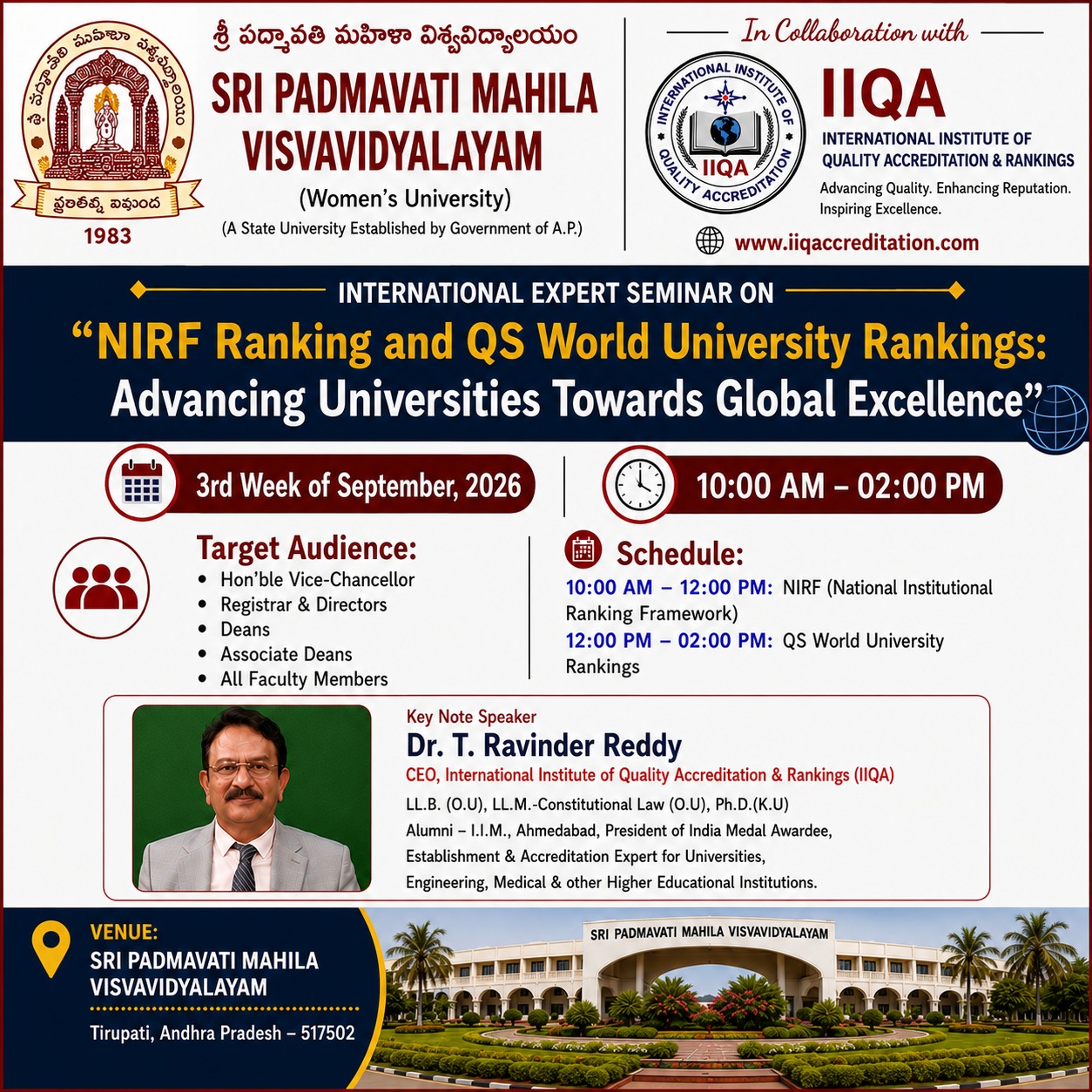
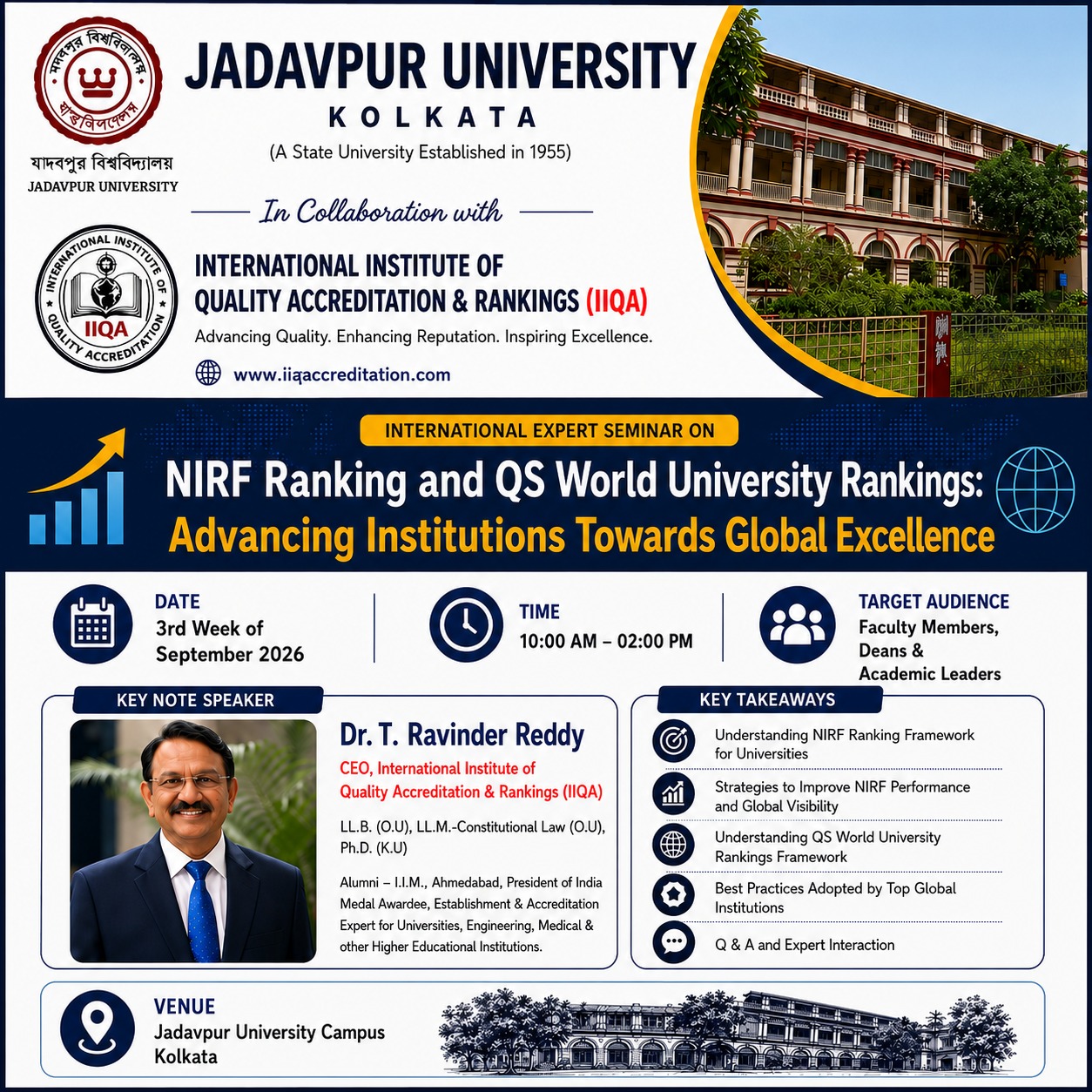
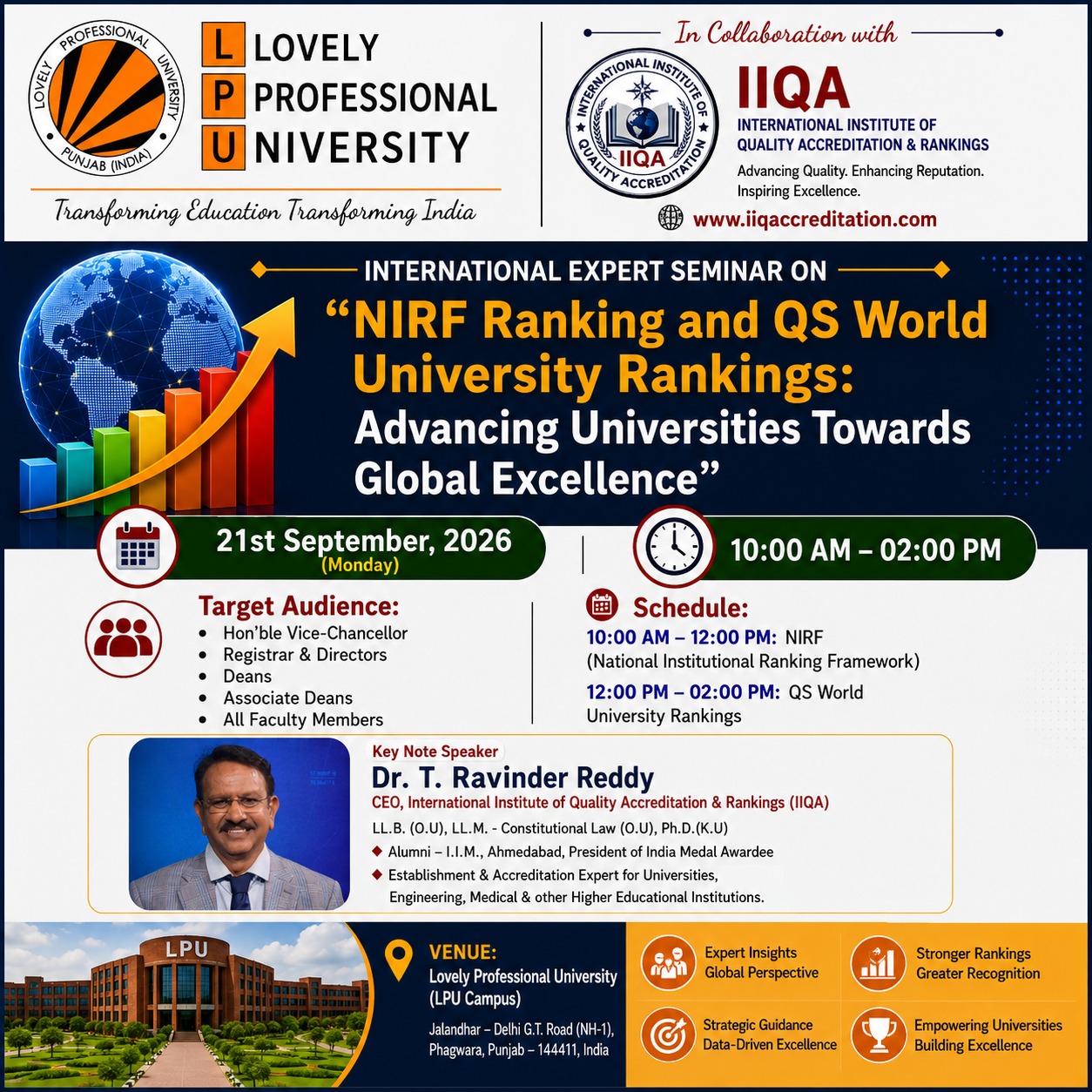
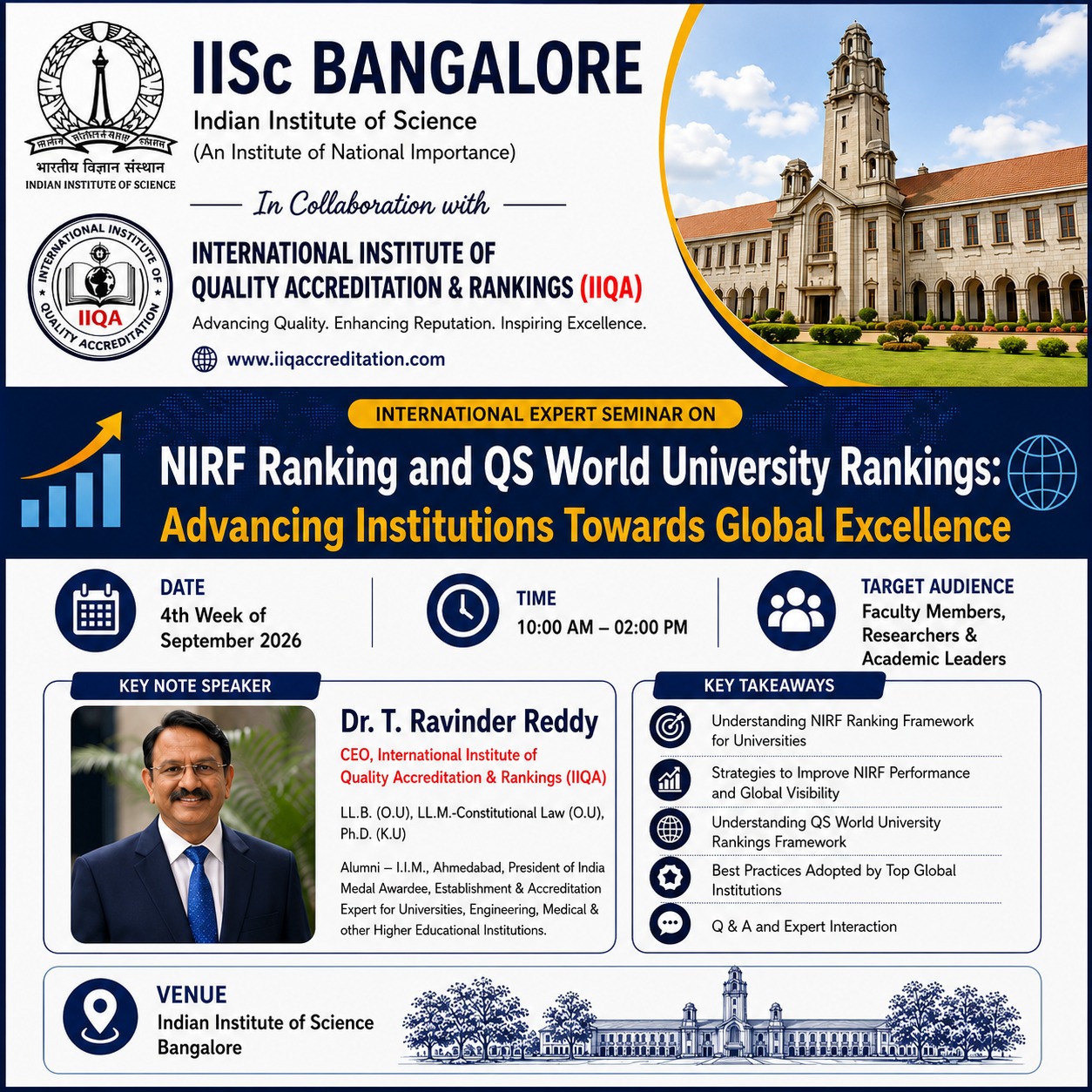
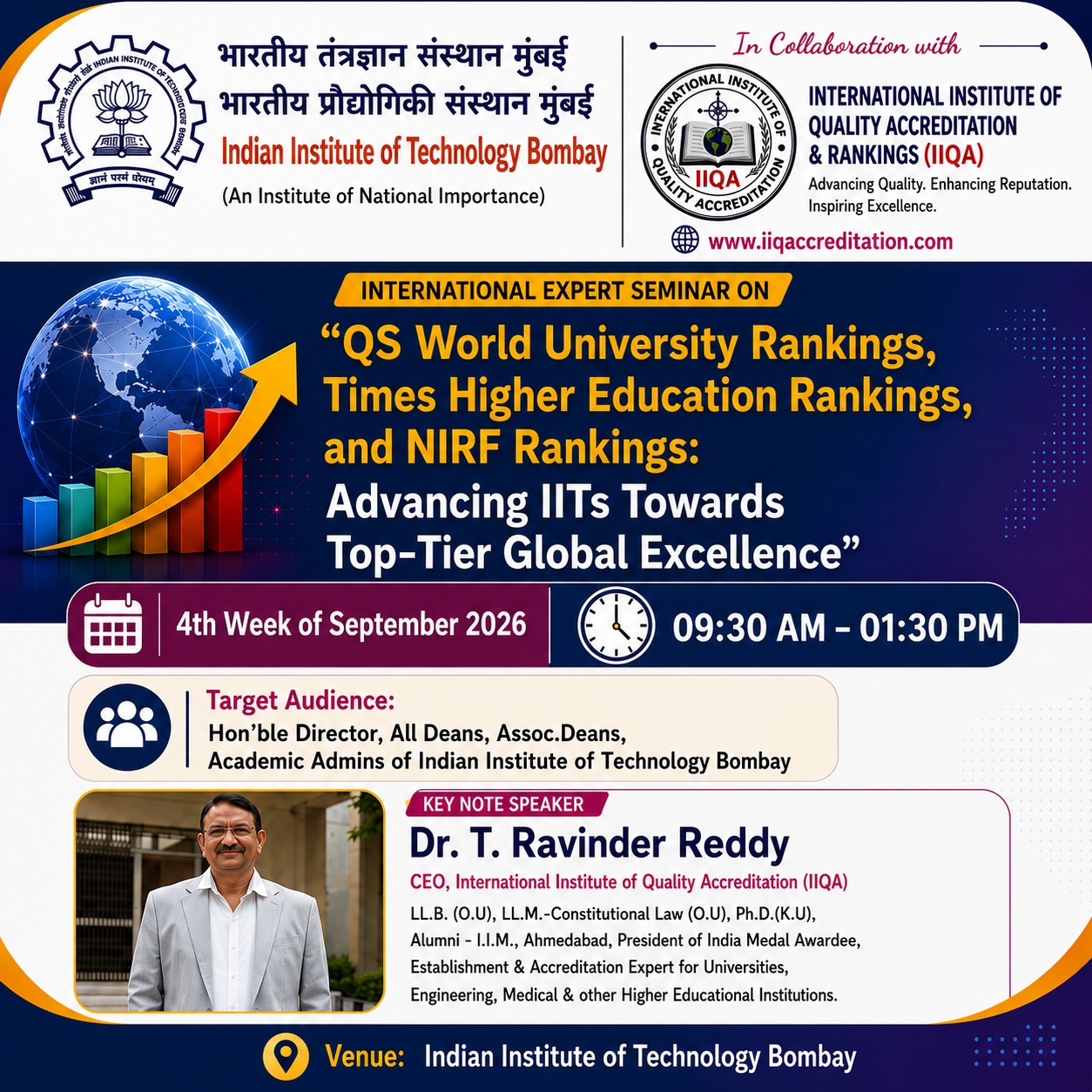
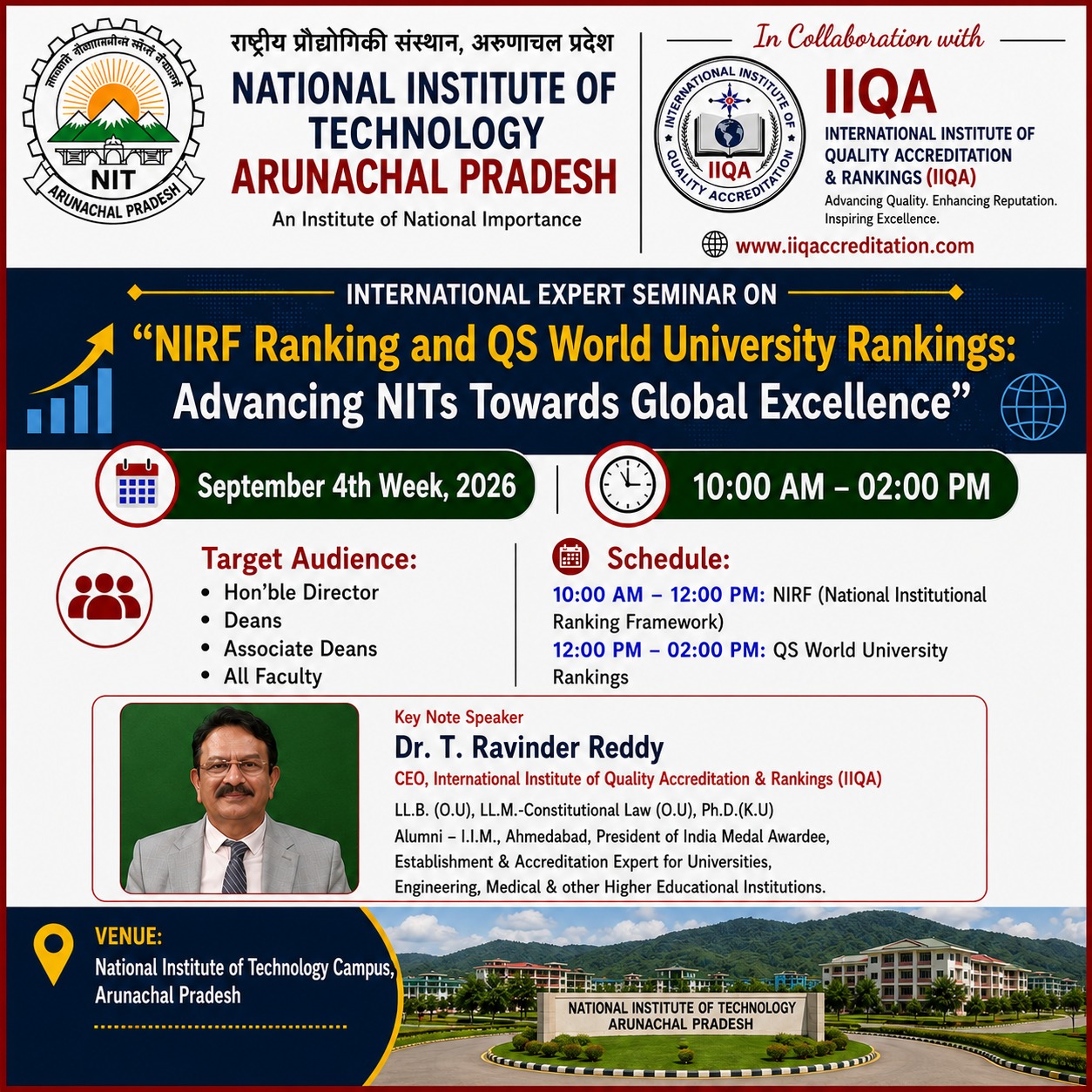
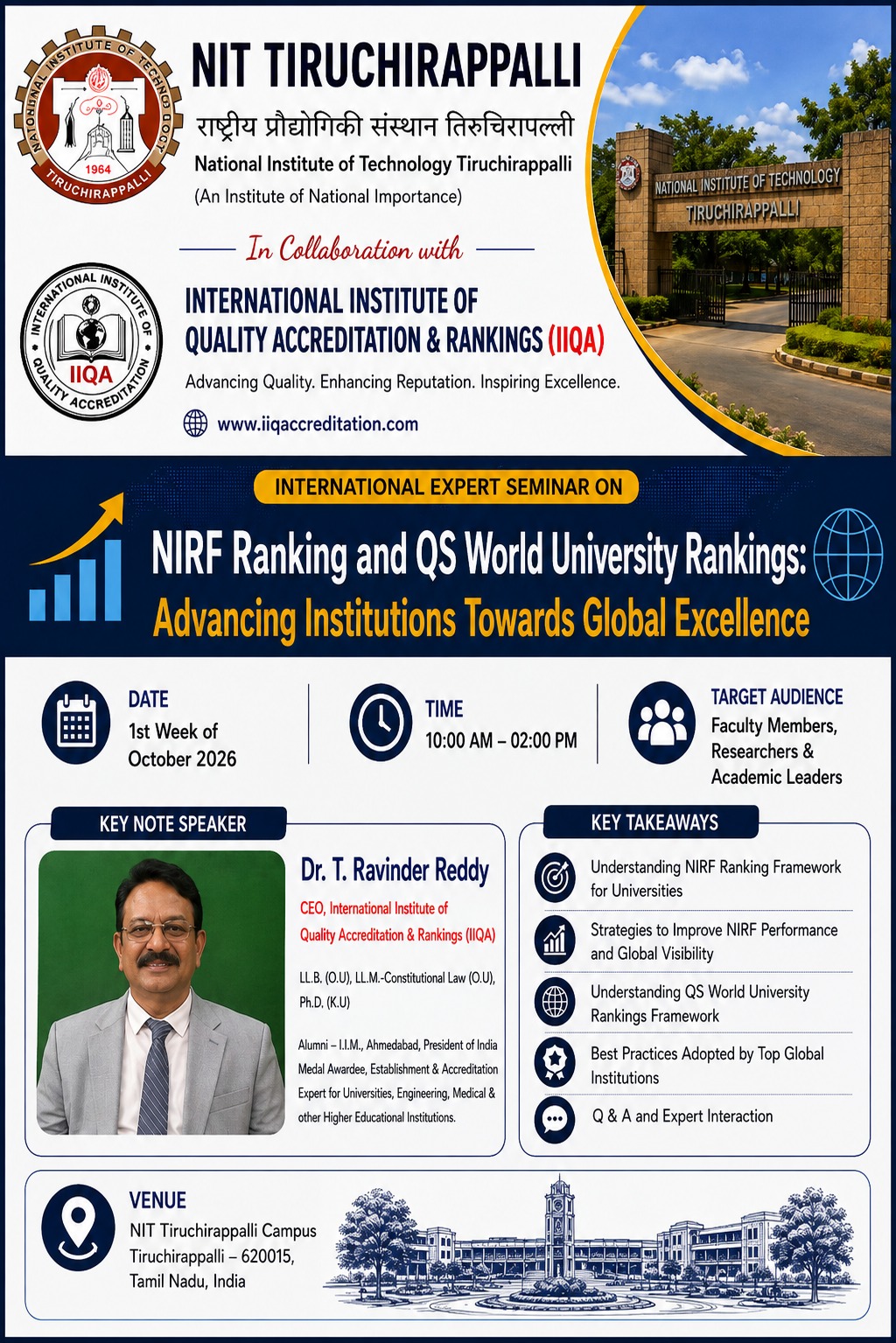
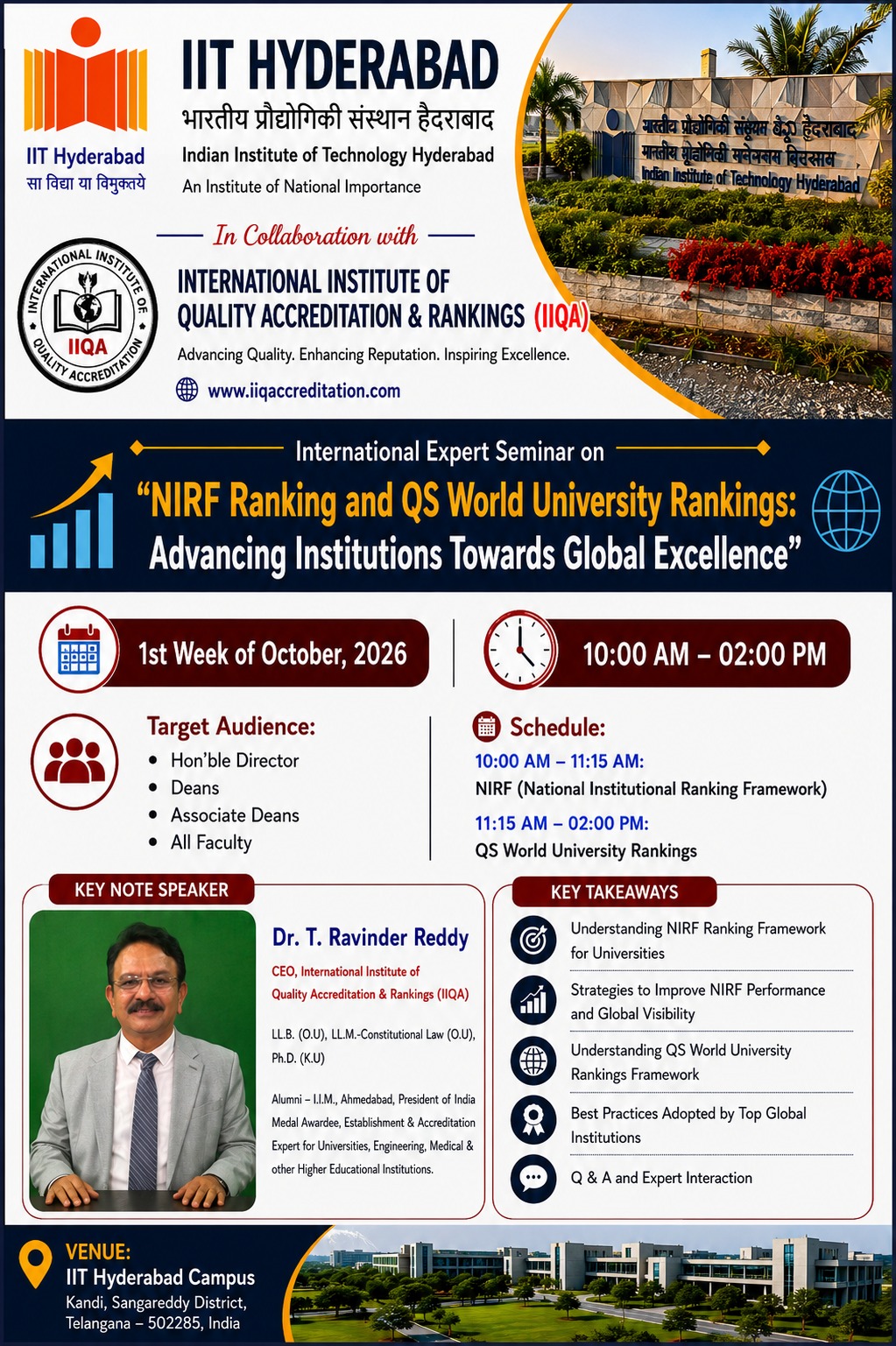
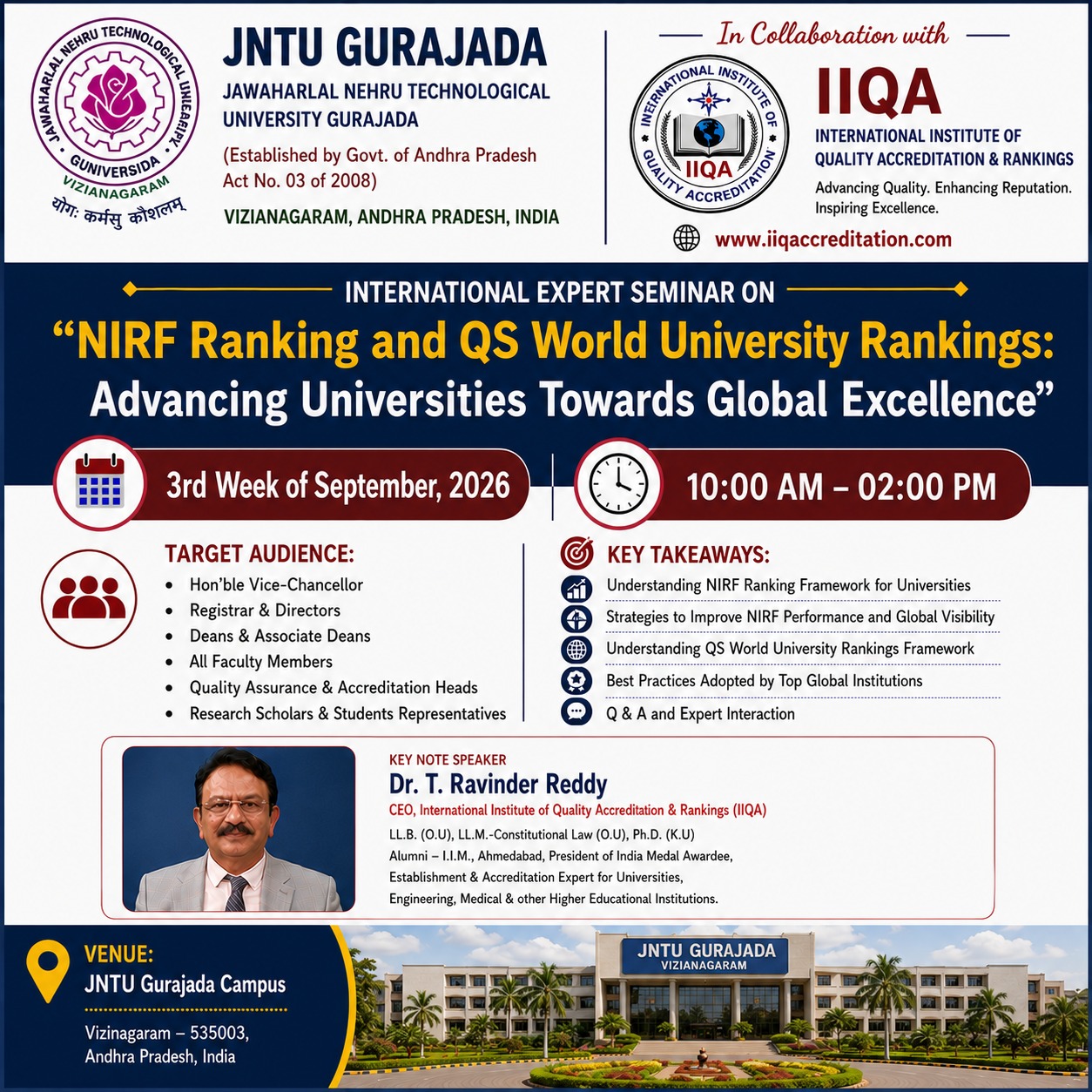
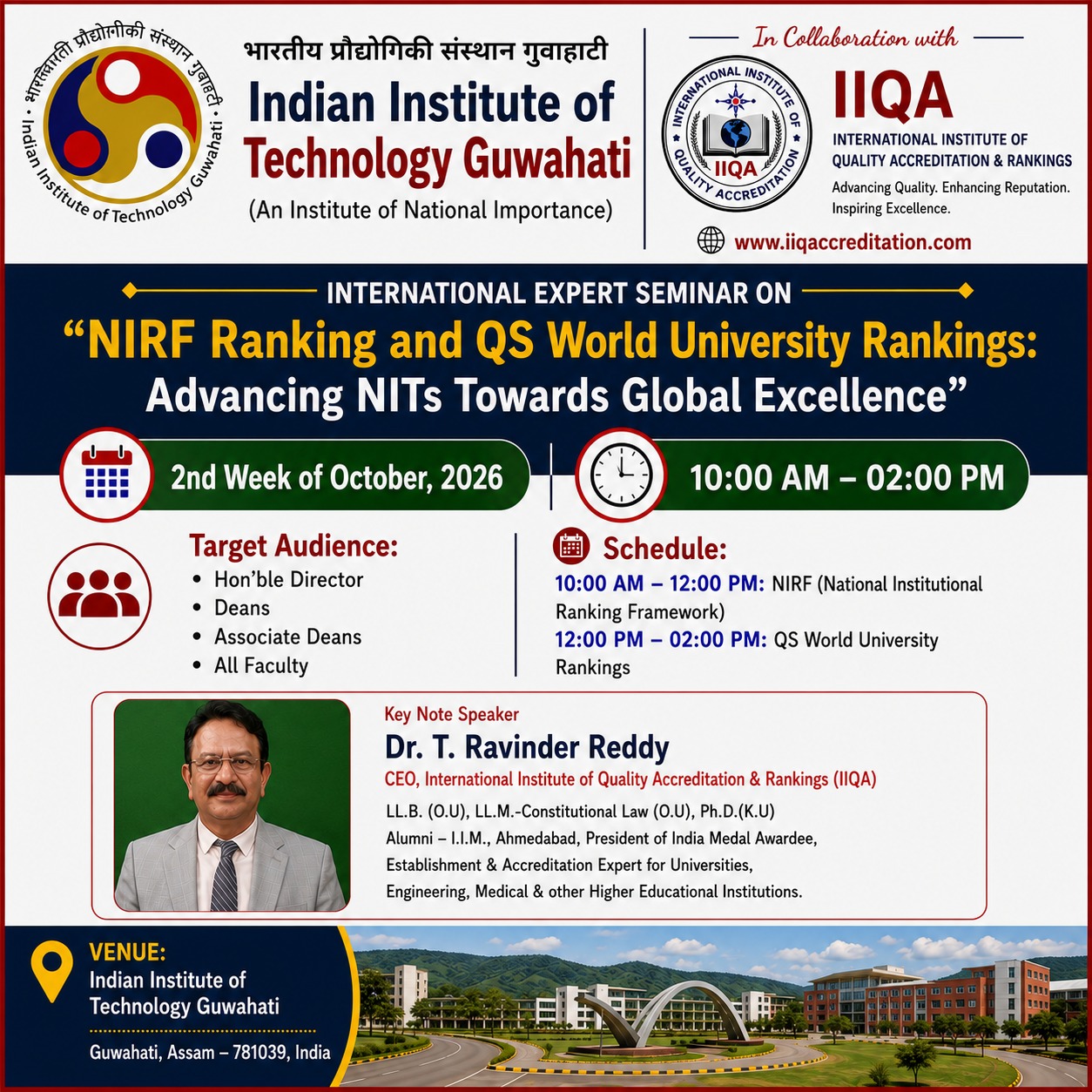
In an era where higher education institutions are increasingly evaluated on their academic performance, research output, international collaborations, and student outcomes, university rankings have become a critical benchmark for measuring excellence. To help educational institutions understand and improve their ranking performance, Visvesvaraya Technological University (VTU), Belagavi, in collaboration with the International Institute of Quality Accreditation (IIQA), is organizing an International Expert Seminar on “QS World University Rankings, Times Higher Education Rankings, and NIRF Rankings: Advancing Universities Towards Global Excellence.”
The seminar is scheduled for 17 June 2026 from 10:00 AM to 4:30 PM at Visvesvaraya Technological University, Belagavi. The event is designed to provide university leaders, faculty members, researchers, and academic administrators with practical insights into national and international ranking frameworks.
About the International Expert Seminar
The seminar aims to bridge the knowledge gap between institutional performance and ranking success. As competition among universities continues to increase globally, understanding the methodologies used by leading ranking agencies has become essential for sustainable growth and academic excellence.
The event will cover:
- National Institutional Ranking Framework (NIRF)
- QS World University Rankings
- Times Higher Education (THE) World University Rankings
- Accreditation and quality assurance practices
- Strategies for improving institutional performance
- Research and publication excellence
- Internationalization and global visibility
The seminar is expected to benefit higher education institutions seeking to strengthen their reputation, attract quality students, improve research output, and achieve national and international recognition.
About Visvesvaraya Technological University (VTU)
Visvesvaraya Technological University (VTU), Karnataka, is the premier state technical university responsible for engineering and technological education across Karnataka. The university functions in a role similar to some of India's largest affiliating technical universities, including:
- Jawaharlal Nehru Technological University Hyderabad (JNTUH), Telangana
- Jawaharlal Nehru Technological University Kakinada (JNTUK), Andhra Pradesh
- Anna University, Tamil Nadu
- Dr. A.P.J. Abdul Kalam Technical University (AKTU), Uttar Pradesh
These universities play a crucial role in shaping technical education by affiliating engineering, management, and technology institutions, prescribing academic curricula, conducting examinations, awarding degrees, and promoting research, innovation, accreditation, and quality assurance initiatives.
Among these institutions, VTU is recognized as one of India's largest technical affiliating universities, overseeing engineering and technology education across Karnataka through its extensive network of affiliated colleges. Through its commitment to academic excellence, research advancement, and institutional quality enhancement, VTU continues to contribute significantly to the development of higher technical education in India.
The organization of an international seminar on QS World University Rankings, Times Higher Education (THE) Rankings, and NIRF Rankings reflects VTU's commitment to helping institutions understand global benchmarking systems and advance toward academic excellence.

Why University Rankings Matter Today
University rankings have evolved beyond simple comparison tools. They now influence student admissions, faculty recruitment, international partnerships, funding opportunities, and institutional reputation.
A strong ranking can help universities:
- Enhance global recognition
- Attract international students
- Strengthen industry collaborations
- Improve research funding opportunities
- Increase institutional credibility
- Benchmark performance against leading institutions
As governments, employers, students, and researchers increasingly rely on ranking data, institutions must adopt strategic approaches to improve their standing.
Understanding NIRF Rankings
What is NIRF?
The National Institutional Ranking Framework (NIRF) is India's official ranking system for higher education institutions. It evaluates universities and colleges across multiple parameters to measure overall institutional quality and performance.
Key NIRF Parameter
1. Teaching, Learning and Resources (TLR)
Evaluates faculty quality, student strength, financial resources, and infrastructure.
2. Research and Professional Practice (RP)
Measures publications, patents, citations, and research funding.
3. Graduation Outcomes (GO)
Assesses placement records, higher education progression, and graduation success rates.
4. Outreach and Inclusivity (OI)
Examines diversity, regional representation, and inclusiveness.
5. Perception (PR)
Measures public and academic perception of the institution.
Why NIRF Rankings Matter
A strong NIRF ranking helps institutions improve visibility, attract quality students, and establish credibility within India's higher education ecosystem.
Understanding QS World University Rankings
The QS World University Rankings are among the most respected global ranking systems. Universities worldwide strive to improve their QS rankings because of the significant impact they have on international reputation.
Key QS Ranking Indicators
Academic Reputation
Based on surveys of academics worldwide.
Employer Reputation
Measures how employers perceive graduates from a university.
Faculty-to-Student Ratio
Indicates teaching quality and student support.
Citations per Faculty
Reflects research impact and scholarly influence.
International Faculty Ratio
Measures global diversity among faculty members.
International Student Ratio
Evaluates the university's attractiveness to international students.
Benefits of Strong QS Rankings
Universities with higher QS rankings often enjoy:
- Enhanced international visibility
- Increased student enrollment
- Better research collaborations
- Greater opportunities for international partnerships
Understanding Times Higher Education (THE) Rankings
The Times Higher Education (THE) World University Rankings evaluate institutions using a comprehensive performance framework.
Major THE Ranking Indicators
Teaching
Learning environment and educational quality.
Research Environment
Research productivity, income, and reputation.
Research Quality
Citation impact and research influence.
Industry Income
Knowledge transfer and industry collaboration.
International Outlook
International students, staff, and research partnerships.
Importance of THE Rankings
THE rankings help universities benchmark their academic and research performance against global standards while identifying areas for improvement.
Seminar Schedule
The seminar has been carefully structured to provide comprehensive coverage of ranking methodologies and improvement strategies.
10:00 AM – 10:30 AM
Inaugural Session
Introduction to the seminar objectives, institutional excellence, and the growing importance of global university rankings.
10:30 AM – 11:30 AM
NIRF (National Institutional Ranking Framework)
A detailed discussion on NIRF methodology, evaluation parameters, data collection, and ranking improvement strategies.
11:30 AM – 1:30 PM
QS World University Rankings
An in-depth exploration of QS ranking indicators, international reputation building, research impact, and global visibility.
1:30 PM – 2:30 PM
Lunch Break
Networking opportunities for participants and institutional representatives.
2:30 PM – 4:30 PM
Times Higher Education (THE) World University Rankings
Comprehensive coverage of THE methodology, teaching excellence, research quality, internationalization, and industry engagement.
Keynote Speaker: Dr. T. Ravinder Reddy
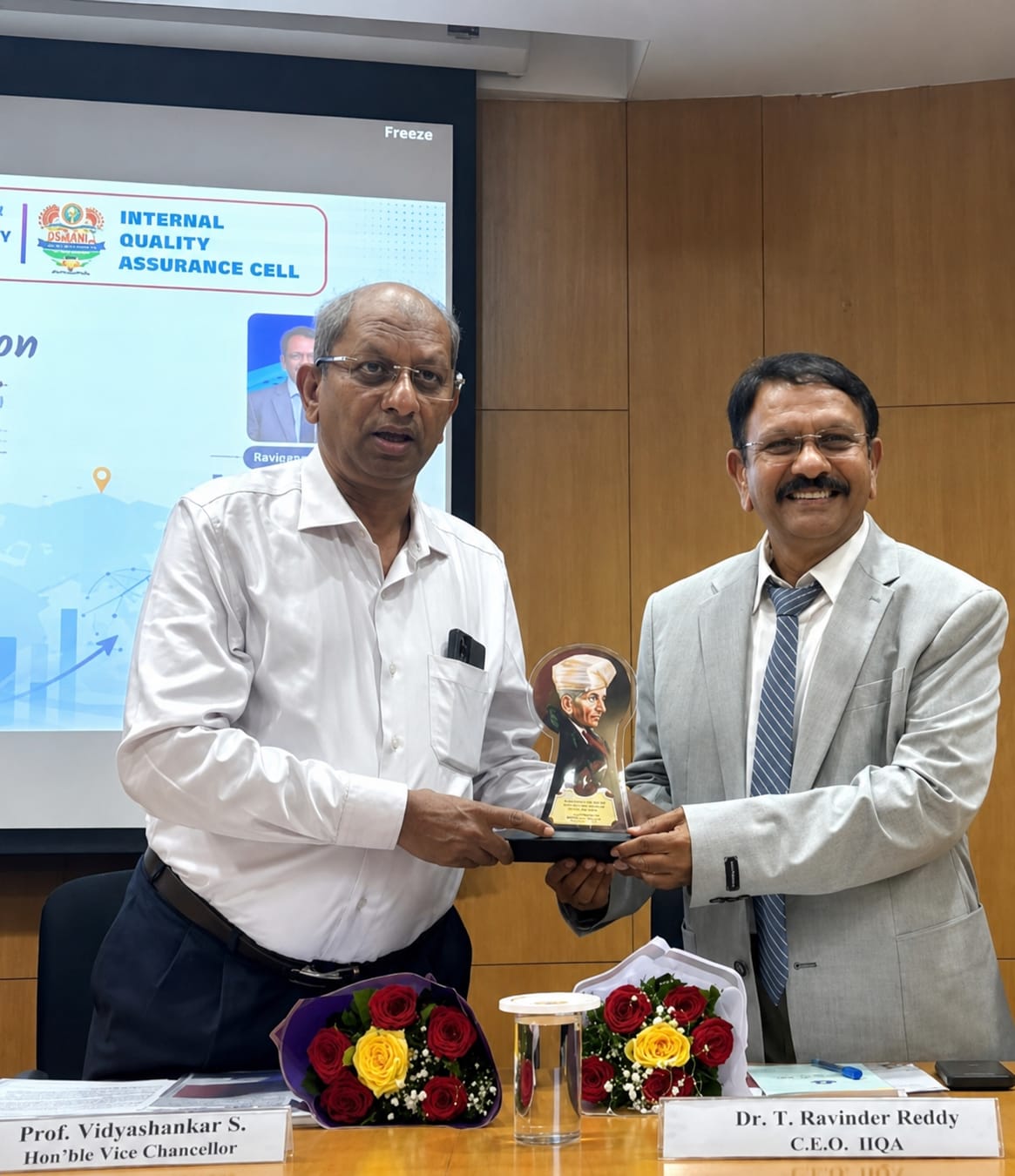
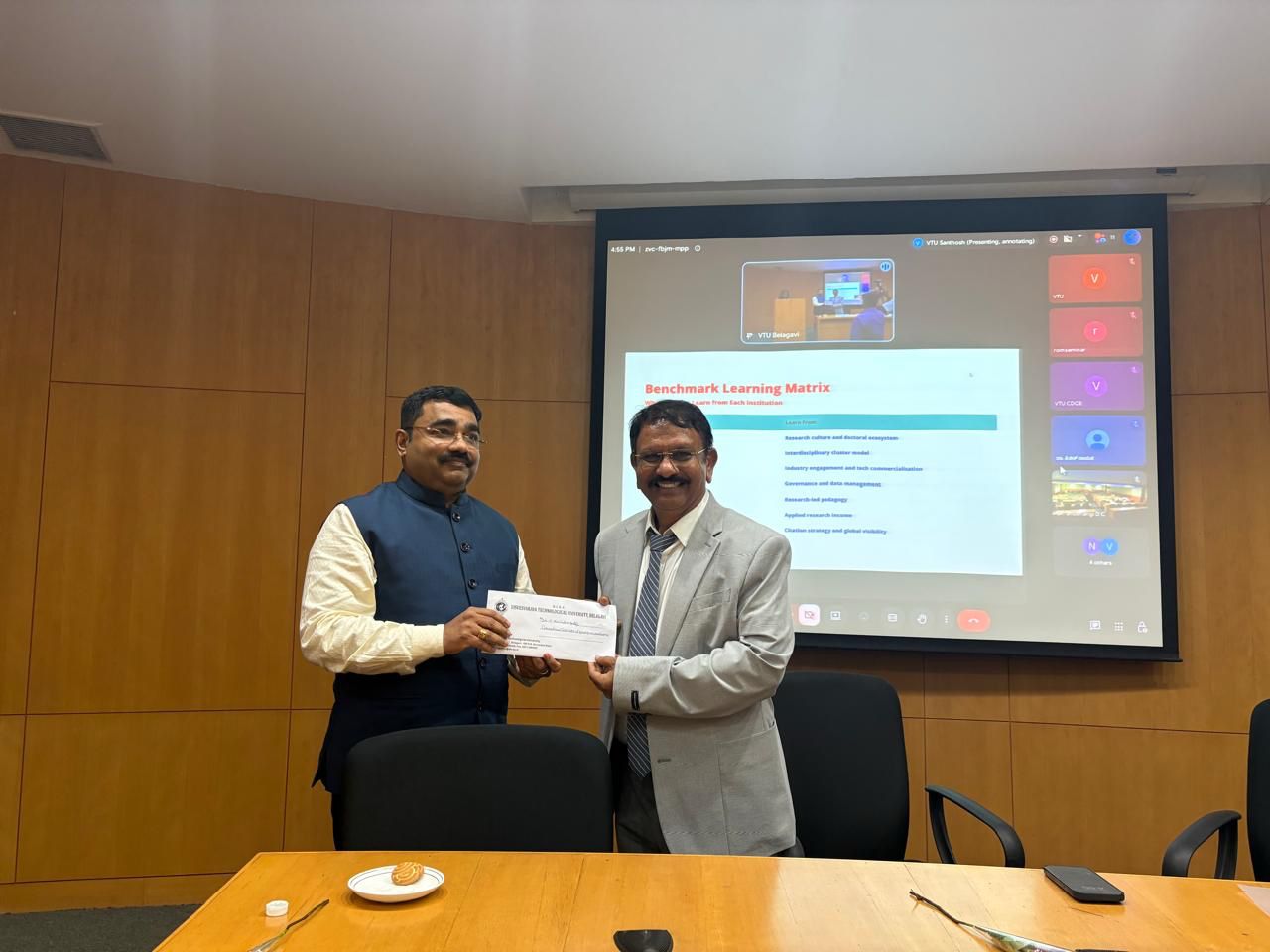
The seminar will feature an expert session by Dr. T. Ravinder Reddy, CEO of the International Institute of Quality Accreditation (IIQA).
Dr. Ravinder Reddy is a distinguished establishment and accreditation expert with extensive experience guiding universities, engineering institutions, medical colleges, and higher education organizations in quality enhancement and accreditation initiatives.
His expertise includes:
- University accreditation
- Institutional quality assurance
- Ranking improvement strategies
- Academic governance
- Research excellence frameworks
- National and international quality standards
Participants will gain practical insights into achieving measurable improvements in ranking performance and institutional effectiveness.
How Accreditation Supports Ranking Success
Accreditation and rankings are closely connected. Institutions that maintain strong quality assurance systems often perform better in ranking assessments.
Benefits of Accreditation
- Continuous quality improvement
- Enhanced academic governance
- Better documentation and reporting
- Improved stakeholder confidence
- Stronger institutional credibility
Accreditation frameworks help universities establish systematic processes that align with ranking requirements.
Strategies Universities Can Adopt to Improve Rankings
Strengthen Research Output
Encourage high-quality publications, collaborative research, and patent development.
Improve Faculty Development
Invest in faculty training, research opportunities, and academic leadership programs.
Focus on Internationalization
Develop global partnerships and attract international faculty and students.
Enhance Student Outcomes
Improve placement support, entrepreneurship initiatives, and skill development programs.
Increase Industry Collaboration
Strengthen partnerships with industry to improve innovation, internships, and research funding.
Build a Data-Driven Culture
Use institutional data to monitor performance and identify opportunities for improvement.
Who Should Attend?
The seminar is specifically designed for:
- Vice Chancellors
- Registrars
- Deans
- Faculty Members
- Researchers
- Academic Administrators
- Quality Assurance Professionals
- Accreditation Coordinators
- Institutional Planning Officers
Participants will gain actionable insights that can be implemented within their institutions to achieve measurable academic and ranking improvements.
Conclusion
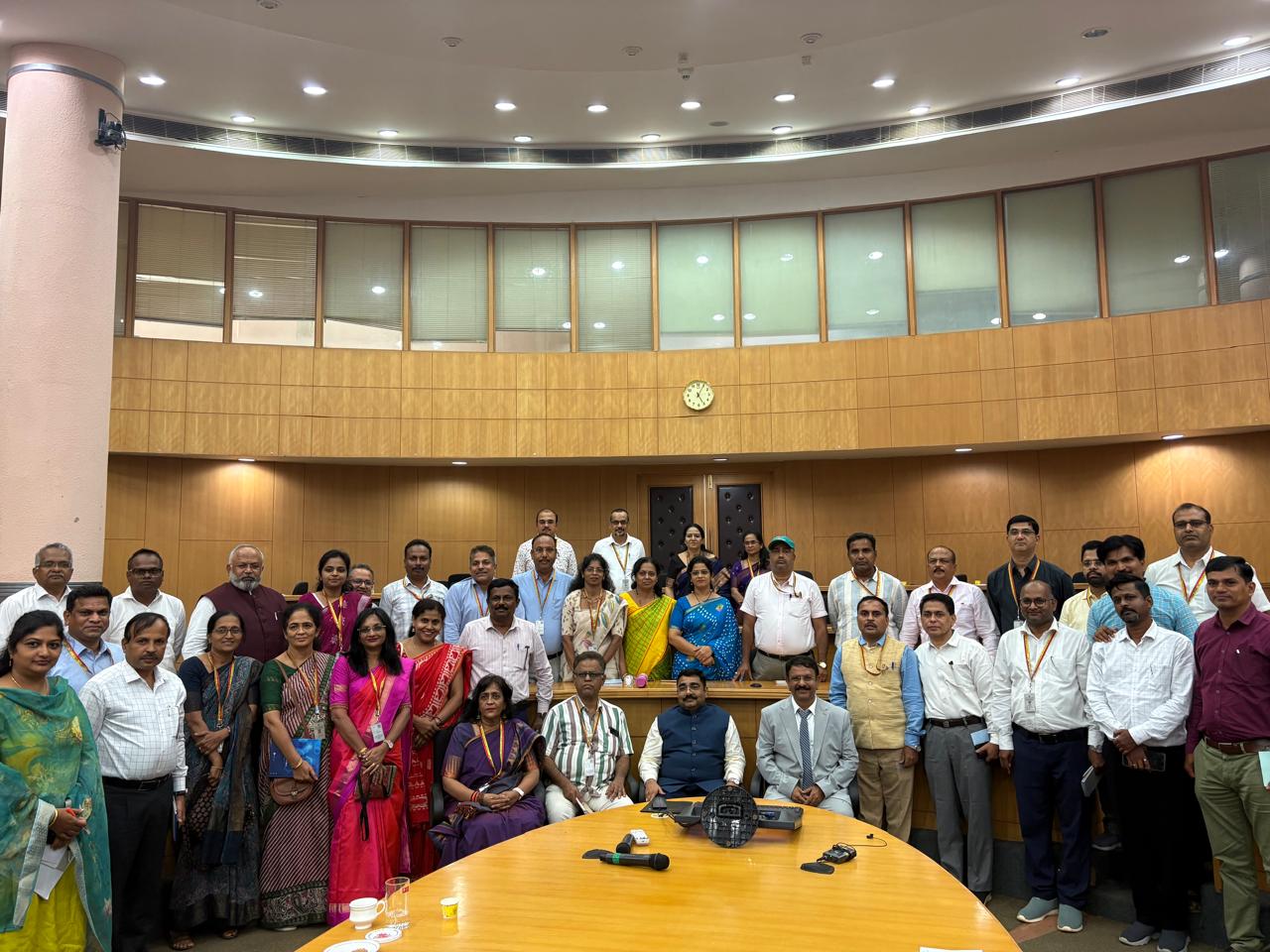
The International Expert Seminar organized by Visvesvaraya Technological University (VTU), Belagavi, in collaboration with IIQA, represents an important opportunity for higher education leaders to understand the evolving landscape of university rankings. By exploring the methodologies behind QS World University Rankings, Times Higher Education Rankings, and NIRF Rankings, participants will gain valuable knowledge to strengthen institutional quality, enhance research performance, and advance toward global excellence.
As universities continue to compete in an increasingly globalized educational environment, understanding ranking frameworks and implementing effective quality assurance practices will remain essential for long-term success.
Frequently Asked Questions (FAQs)
1. What is the objective of the VTU and IIQA seminar?
The seminar aims to educate higher education institutions about QS, THE, and NIRF ranking systems and strategies for improving institutional performance.
2. Why are QS World University Rankings important?
QS rankings enhance global visibility, improve reputation, and help attract international students and research collaborations.
3. What topics will be covered during the seminar?
The seminar will cover NIRF rankings, QS rankings, THE rankings, accreditation practices, research excellence, and ranking improvement strategies.
4. Who is the keynote speaker for the seminar?
Dr. T. Ravinder Reddy, CEO of IIQA and an experienced accreditation expert, will deliver the keynote session.
5. How can universities improve their ranking performance?
Universities can improve rankings through stronger research output, faculty development, internationalization, industry collaboration, and quality assurance practices.
6. How does accreditation influence university rankings?
Accreditation strengthens institutional quality systems, improves governance, and supports many of the performance indicators used in ranking methodologies.